Penny Rounding on Cash Transactions: How FieldStack Makes It Easy

The penny elimination raised a lot of questions for retailers: How should rounding be applied? Where should it live in the transaction? And how do you implement it without affecting pricing or reporting?
In a recent blog post, we broke down the broader “penny problem” — what’s happening with penny production, what rounding means for retailers, and why rounding change (not prices) is the cleanest approach.
The next question we kept hearing was more specific:
How does that logic actually get built into a POS system without disrupting daily operations or customer trust?
This post focuses on exactly that — how we implemented penny rounding in the FieldStack platform quickly, cleanly, and with flexibility for real-world retail operations.
Why Penny Rounding Is an Operational Problem, Not Just a Policy One
Federal and state guidance around pennies has been minimal and, in some cases, inconsistent. That’s left retailers to make their own decisions about how to handle cash transactions — often across multiple locations with different customer expectations.
But the real risk isn’t rounding itself. It’s where and how rounding is applied.
Retailers told us they were worried about:
- Rounding affecting item prices or taxes
- Reporting and accounting inconsistencies
- Complicated return scenarios
- Hard‑coded POS behavior that couldn’t adapt by location
So instead of treating this as a pricing problem, we treated it as what it really is: a cash‑handling event that needed to be explicit, auditable, and configurable.
How FieldStack Implemented Penny Rounding
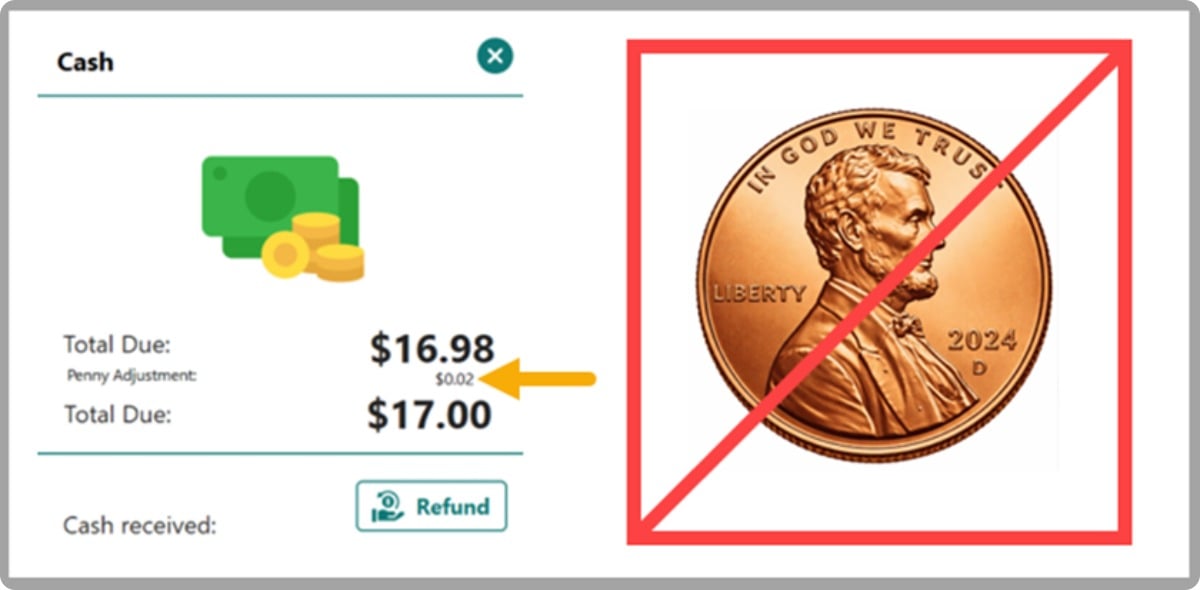
Above: We added a simple solution to the "penny problem" right into the POS.
Location‑Level Control
We recently introduced penny rounding to our platform as a location setting, not a global system rule.
Each store can choose the approach that aligns with its service model and customer expectations.
There are 4 options:
- Do not round
- Round down to the nearest nickel
- Round up to the nearest nickel
- Round to the nearest nickel (up or down)
This flexibility matters for multi‑location retailers operating in different states, markets, or competitive environments.
Rounding Happens After the Sale — Not Inside It
One design principle guided everything we built:
The sale total should never change.
With FieldStack:
- Shelf prices, line items, discounts, and taxes are calculated exactly as they always have been
- The transaction total remains accurate down to the cent
- Rounding is applied only after the Cash button is tapped
At that point, a clearly defined line item — Penny Adjustment — is added to the transaction.
This makes rounding explicit, traceable, and separate from pricing logic, which keeps reporting, analytics, and accounting intact.
Cash Payouts, Returns, and Real‑World Edge Cases
Rounding logic shouldn’t fall apart the moment something unusual happens — and retail is full of edge cases.
Cash Payouts
For cash payouts, rounding is applied in the opposite direction to remain customer‑friendly.
- Card refunds are issued for the exact amount
- Cash refunds apply rounding only to the physical cash returned
For example, if a store rounds down in the customer’s favor during a sale, it will round up in the customer’s favor when issuing a cash payout.
Returns and Refunds
Returns always reference the original transaction total, not a rounded amount.
There’s no retroactive adjustment and no manual intervention required.
Why This Approach Matters
Handling the penny shortage isn’t about squeezing or losing a few cents. It’s about clean execution.
By treating rounding as a cash‑handling event rather than a pricing change, FieldStack allows retailers to:
- Roll out penny rounding quickly without retraining chaos
- Maintain clean reporting and reconciliation
- Avoid customer confusion or disputes
- Adapt policies by location without fragmenting data
This is exactly how modern retail systems should handle regulatory gray areas and operational change.
The Bottom Line
When the penny situation changed, retailers needed a clear solution in their POS — not a workaround.
We built the setting, rolled it out, and gave stores control over how to handle cash. Pricing stays intact. Reporting stays clean. Teams don’t have to rethink their process.
That’s the goal anytime operations shift: handle it clearly, keep it simple, and let retailers focus on their business.
Want more insights on how FieldStack handles operational changes like this? Subscribe to the blog: